Design & Communication
Research Before Redesign: What User Interviews Can Tell You That Analytics Cannot
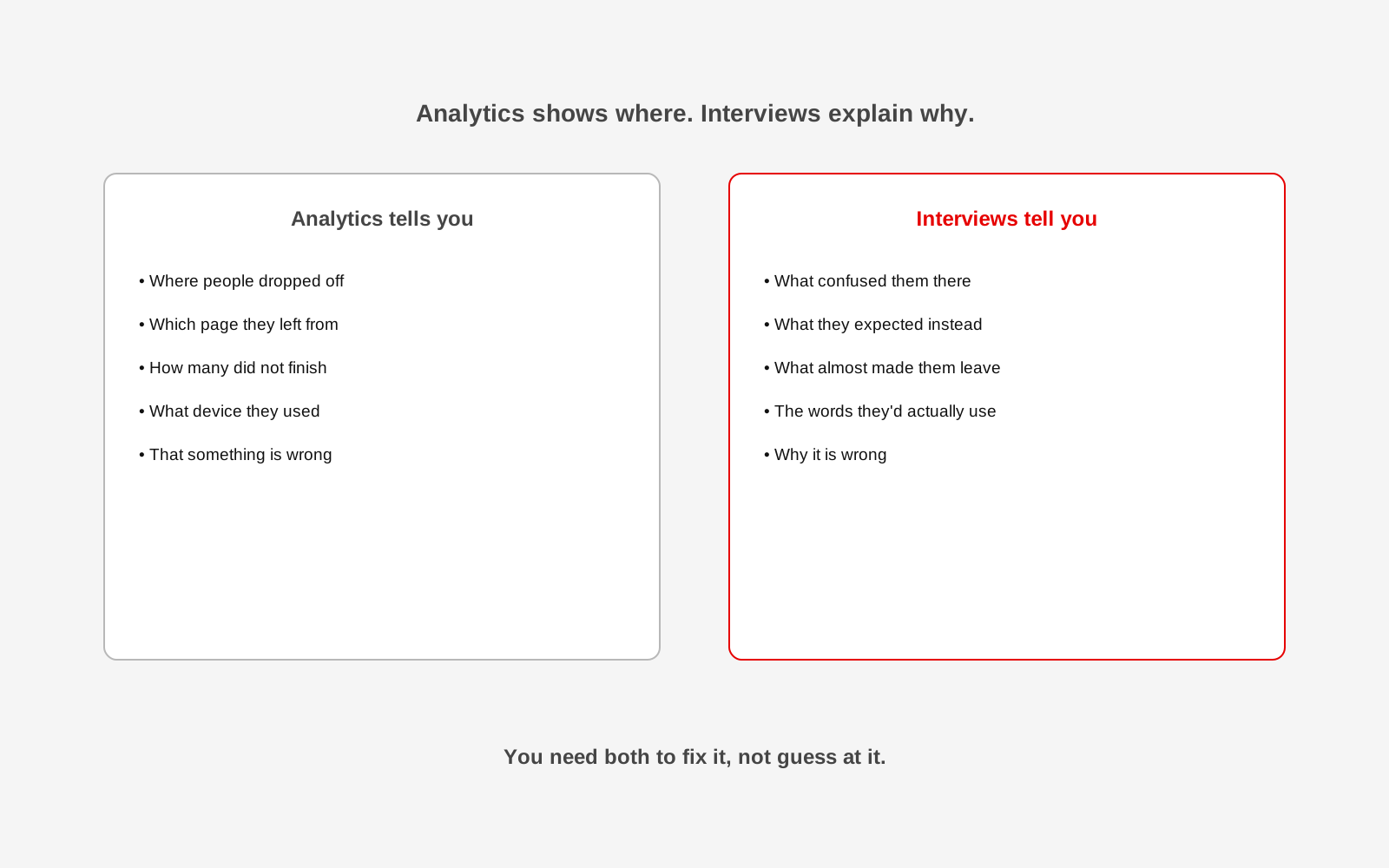
Analytics can tell you that seventy percent of visitors leave a page without completing a form. It cannot tell you why. A redesign built on that gap alone is a guess wearing the costume of a decision.
Interviews and analytics answer different questions, and a redesign that only asks one of them is working with half the picture.
Analytics is very good at where, and very bad at why
A drop-off, a slow page, a form abandoned halfway through, analytics will show all of this reliably, at scale, without needing anyone's time. What it cannot show is intent: whether someone left because the form was confusing, because they were interrupted, because they changed their mind, or because they were never going to complete it regardless of the design. Several very different problems can produce an identical chart.
Interviews fill in the reason, in the user's own words
Watching or listening to someone actually attempt a task surfaces the specific moment of confusion: the label they misread, the field they didn't understand was required, the assumption they made that the design never accounted for. That level of detail rarely survives translation into a spreadsheet.
Small samples are still useful here
Usability research does not need the sample size a statistical survey does. A handful of well-chosen interviews, watching real people attempt real tasks, consistently surfaces the same handful of friction points. After five or six sessions, new interviews tend to confirm what earlier ones already showed rather than reveal something entirely new.
Ask people to do the task, not just describe it
What someone says they would do and what they actually do when given the task are often different. Watching someone attempt to find a phone number or complete a form reveals real friction that a hypothetical question rarely does. "Try to book an appointment on this page" teaches more than "how do you feel about our appointment process".
Use analytics to decide where to look, interviews to decide what to fix
The two are not competing methods, they are sequential ones. Analytics is efficient at pointing to the pages and steps worth investigating. Interviews are what turn that pointer into an actual explanation the design team can act on.
Watch for the gap between what people say and what they do
Someone might say a form felt fine and still visibly hesitate at a particular field during the session. The hesitation is usually more honest than the verbal answer given afterwards. Pay attention to both, and trust the behaviour more than the self-report when they disagree.
Bring the evidence back to the room, not just a summary slide
A short clip of someone struggling with a real task tends to change a stakeholder's mind faster than a paragraph describing the same struggle. Where consent allows, real moments from research are far more persuasive than a bullet-point summary of what was found.
This is not new to Studio 1947's own process
Task-based understanding, not assumption, shaped the information architecture on projects like the Jan Sahas Social Empowerment Society website and AWCH: designing around what people actually needed to accomplish, verified directly rather than guessed at from a dashboard. The same discipline underlies planning any website redesign properly, rather than jumping straight to new screens.
You need both to fix it, not guess at it
Studio 1947 works across research and design to understand a problem properly before redesigning around it. See our Research & Survey and Data, Design & Tech work, or talk to us before your next redesign.