Local Business & Tourism
How Small Tourism Businesses in Darjeeling Can Get Found Online: Google, OTAs, Websites and Reviews
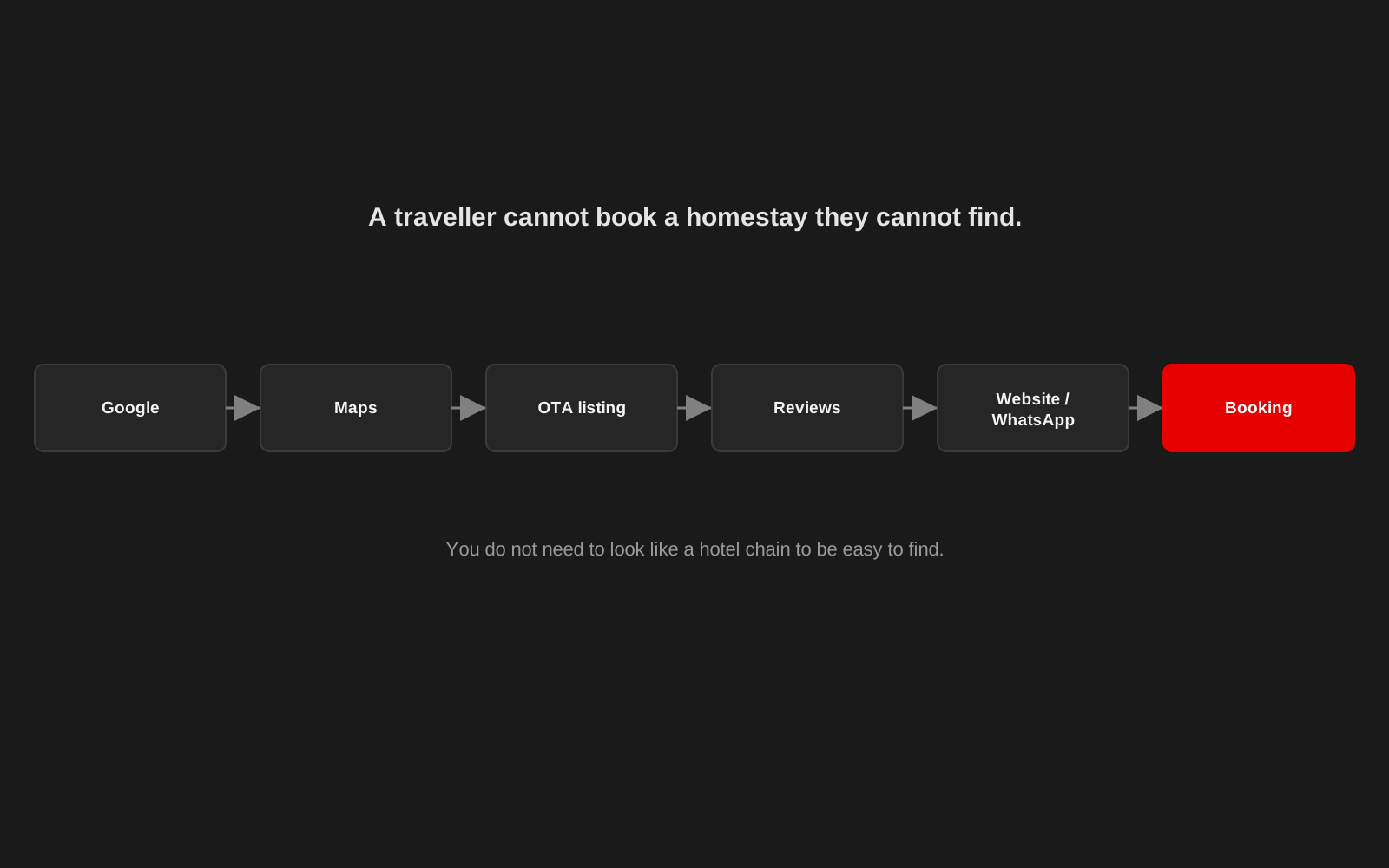
A traveller cannot book a homestay they cannot find. In Darjeeling, Mirik and the surrounding hills, many small tourism businesses still depend heavily on referrals, drivers, local contacts and repeat guests.
Those channels matter. But the first-time traveller increasingly starts somewhere else: Google Search, Google Maps, an OTA, Instagram or a recommendation shared on WhatsApp. Getting found online does not require becoming a large hotel brand. It requires making the basic information easy to discover, trust and act on.
Start with Google Business Profile
For a local tourism business, Google Maps may matter more than the homepage. Check that the listing has the correct business name, an accurate map location, a working phone number, the correct category, check-in or business information where supported, a website or booking link, current photographs and a useful description. Avoid creating several duplicate profiles for the same property. If the map pin is wrong, fix it. In hill areas, a small location error can send a guest to the wrong road entirely.
Photographs answer practical questions
Beautiful mountain views help, but guests also want to know what they are booking. A useful photo set should include the property exterior, the room from more than one angle, the bathroom, the common area, the view if relevant, food or the dining area, the approach road or entrance, parking information where relevant, and the host or team, with consent. Use recent photographs that match the current condition of the property. Over-edited images may increase clicks and decrease trust when the guest arrives.
Be present on the right OTAs
Online travel agencies can provide discovery and booking infrastructure that a small property may not want to build itself. The right platforms depend on the property and target traveller. Keep room names, policies, photographs, contact information and availability consistent across platforms. If a property is listed as "Deluxe Valley View" on one platform and "Standard Room" on another, staff can easily create confusion during booking.
Reviews are part of local search
Guests read reviews to reduce uncertainty. Encourage genuine guests to leave honest feedback after their stay. Do not buy reviews or ask people who never stayed to post them. Respond calmly to both positive and negative reviews. A useful response acknowledges the experience, gives factual context where needed and explains what was improved. An argument with a guest in public rarely helps the next person reading it.
A website still has a role
An OTA profile belongs to the platform. A website belongs to the business. A simple site can give travellers a clear source for rooms, location, photographs, local experiences, the host's story, contact details, direct enquiry, policies, directions and nearby places. It can also help the business appear for searches that are more specific than its name. For a small homestay, the website does not need dozens of pages. It needs accurate information and an easy way to enquire.
Make WhatsApp useful, not chaotic
WhatsApp is often part of the booking journey. Use a dedicated business number where possible, create simple quick replies for common questions, and keep booking details organised outside a personal chat history. A useful first response might confirm requested dates, number of guests, room availability, rate, meal inclusion, the payment or confirmation process, and a location link. Do not make guests send the same details repeatedly to different people.
Write for the actual place
A generic page that says "experience nature and serenity" gives search engines and travellers very little information. Be specific: explain whether the property is in Mirik, Soureni, Kurseong, Darjeeling town or another area, mention realistic travel context and nearby attractions where relevant, and describe what guests can actually experience. Do not claim to be "near Darjeeling" if the journey takes several hours. Specific local information creates better search relevance and better expectations.
Local language can help operations
Your public website may primarily target Indian and international travellers in English, but local-language material can still be useful for staff, partners and regional audiences. It is the same question any multilingual website project has to answer first. Choose languages based on actual users rather than adding translations for decoration.
Track where enquiries come from
Ask guests how they found the property. Where possible, also use Google Business Profile insights, website analytics, UTM-tagged campaign links, OTA booking reports, and a simple source field in your booking record. You do not need a large analytics system to learn whether most bookings come from Maps, an OTA, Instagram or repeat guests.
Do not depend on one platform
Platforms change commissions, ranking systems and policies. A healthier mix may include Google visibility, one or more OTAs, direct website enquiries, WhatsApp, social media, local partnerships, repeat guests and referrals. The goal is not to remove intermediaries completely. It is to avoid becoming invisible if one channel changes.
A local example
Studio 1947's work with Bhagirath Homestays began with a small hospitality business in Mirik that had no online presence at all. Within six months of listing it on the right platforms, the property had sold over 100 room nights and earned more than ₹1.5 lakh. Work of this kind is not only about building a site. It is about connecting listings, content, platforms and direct contact so a traveller can find the property and feel confident enough to enquire. That is the practical digital problem many small tourism businesses in the hills share.
You do not need to look like a hotel chain to be easy to find online
Studio 1947 is based in Mirik and works with local businesses on websites, digital discovery, communication and practical systems that fit the way they operate. See our Communication & Campaign and Data, Design & Tech work, or talk to Studio 1947 about getting found online.