Packing for college was exciting for Imu. For the first time she was leaving the hometown where she had spent seventeen years, to study in another state. Her stomach filled with a heavy sense of doom, probably just excitement and nerves. She double-checked everything in the brown trolley her elder sister had packed for her.
Two Sisters and a Packing List
Eeee! Aecha aesya? Ngada. Nga aecha thuwe gimbaw gumda! Aecha nu chi Etopolo ni Thuwe. Naniapiya mein college gimbana laada. Eeee. Ngada. Kesha gum. Nga gimbaw gum. Yoh! Gimbana. Ngada. Ngada. Ngada!!
Eee. What is this? No! I am not taking this thuwe with me. This is your Etopolo and Thuwe. Naniapiya told you to take it to college. Eeee. No. It is not even pretty. I am not taking it. Oh c’mon. Take it with you. No. No. No!!
The sisters went back and forth for more than half an hour. Then it was settled. Imu would take her ‘boring’ traditional Etopolo (top) and Thuwe (wrap around skirt) to college. She kept her end of the bargain. But she promised herself those clothes would not leave her bag any time soon.
Indigenous Faith Day Arrives
College began, and with it new adventures and lessons. Days became weeks, weeks became months. Soon it was Indigenous Faith Day in Arunachal Pradesh. All around her, tribal students were excited to show off their traditional dress. Imu felt nervous at the thought of wearing hers.
What Idu Mishmi Textiles Look Like
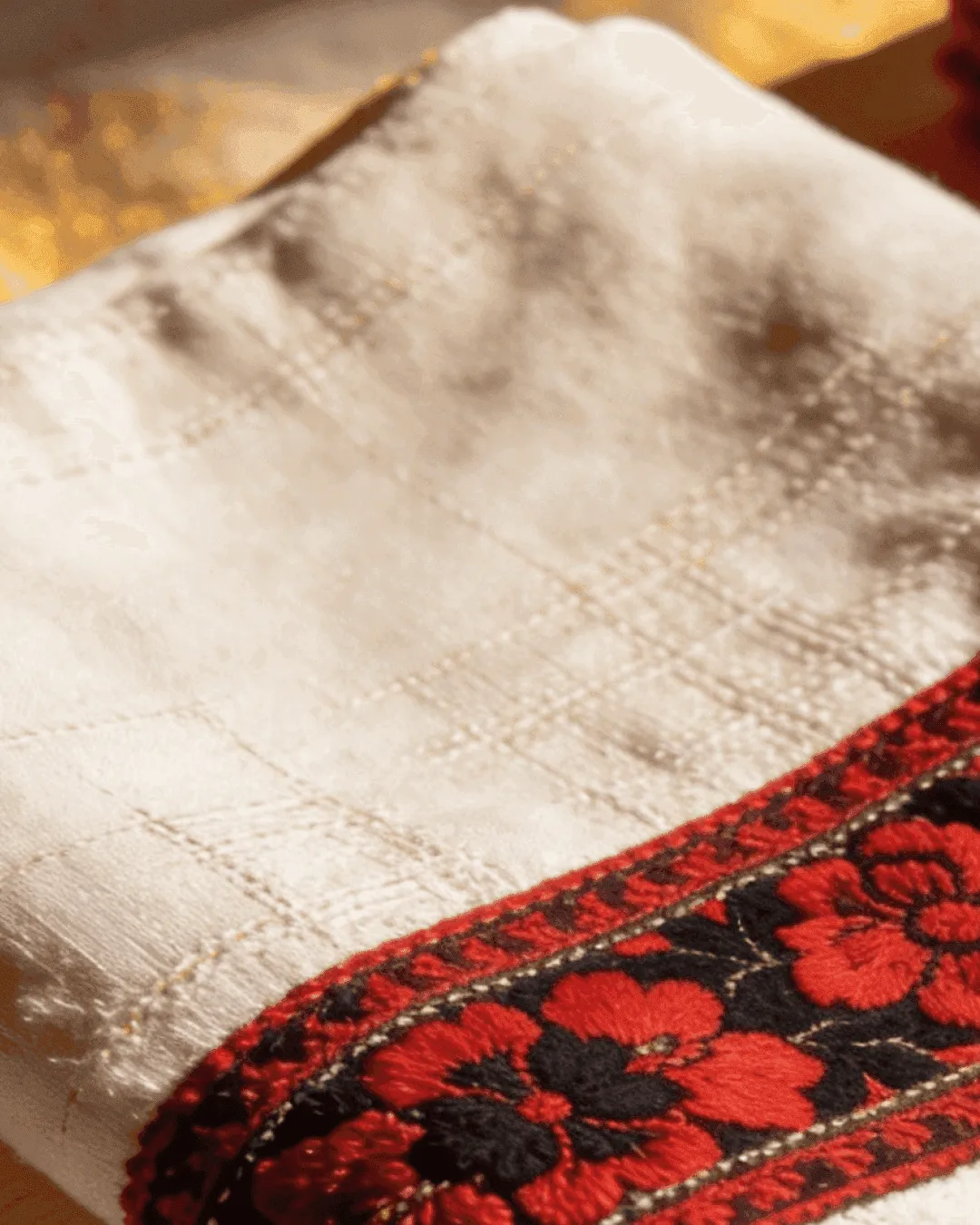
The Idu Mishmi textile pattern is built from simple geometric shapes, decorated with smaller colourful ones. The main colours in Idu Mishmi textiles are black, dark or bright orange, and white. Each kind of cloth has its own colour theme. A traditional Thuwe, the wrap around skirt, is mostly black, dark or bright orange and white, with shimmering yarn for decoration. The design on a Thuwe is woven on a black background: rows of diamond motifs, each filled with smaller diamonds in shiny silver, white, green or bright orange. The everyday coat, the Etoma, uses the same colours as the Thuwe. Another coat, the Anatubru, is more colourful, with bright yellow rectangular strips and black, red and green geometric embroidery. The warrior coat, the Etondre, is made from thicker yarn or wool. It is mostly a symmetrical black and white design.
Weaving on a Wooden Loom
In earlier days the Idu Mishmi made yarn from nettle plants and used natural plant dyes for colour. Every loom set was different, with many parts for many kinds of clothing. Because everything came from natural raw materials, the work was slow. One piece could take four to five months. So each piece was valued, and cost a lot. Imu remembered how, when she was in high school, her naniapiya wove different sets of Thuwe for different occasions. The simpler ones, mostly in a single colour, took a week and cost around 1000-1500 Rs. The ones with Joṁ (embroidery or woven designs) cost much more, given the time and precision each one took. Those started from 3000-6000 Rs.
Lessons at the Loom
Imu remembered helping her aunty set up the wooden loom at the start of a weave. She would pass the ball of black yarn to her aunty, who sat in front of the loom. One hand waited for the ball at point A and passed it to the other hand through the horizontal opening at point B. They repeated this until a black piece of the right shape appeared. All the while they swapped stories from everyday life, curious happenings, home remedies, and lessons from school and the farm.
In the Mirror
As the D-day came closer, Imu kept wondering. Would her outfit be pretty enough, or too plain and simple? With a pinch of nerves and a bucketful of hope, she looked in the mirror. She looked pretty. Why had she thought her clothes made her ugly? Maybe they seemed boring because she had watched them being made from simple balls of yarn. She had worn them so many times, on so many occasions, that she forgot how colourful they were and how beautiful they made her feel. She wore a lekopo, a traditional necklace of small white beads and bigger red beads, her silver earrings or andisu, and her aakuchi (purse). Together they made her look like her naniapiya, her mother’s elder sister.
Mimi's Adi Gale
Her Adi friend Mimi was in her traditional dress too: a dark black Ulta Galuk (top) and a bright red Gale (wrap around skirt) with thin black horizontal rows. She finished the look with a traditional necklace, the Aane, made of silver coins and beads.
Roots and the Modern World
The two friends joined their classmates, all wearing their traditional dress with pride. Imu realised how important her clothes made her feel. Every outfit was different, colourful and beautiful. Each one had a story to tell and a tradition to keep and be proud of. She was a link between her roots and the modern world. Her embarrassment fell away as she walked hand in hand with her friends. The sun shone on the procession, and a smile broke into her young heart.