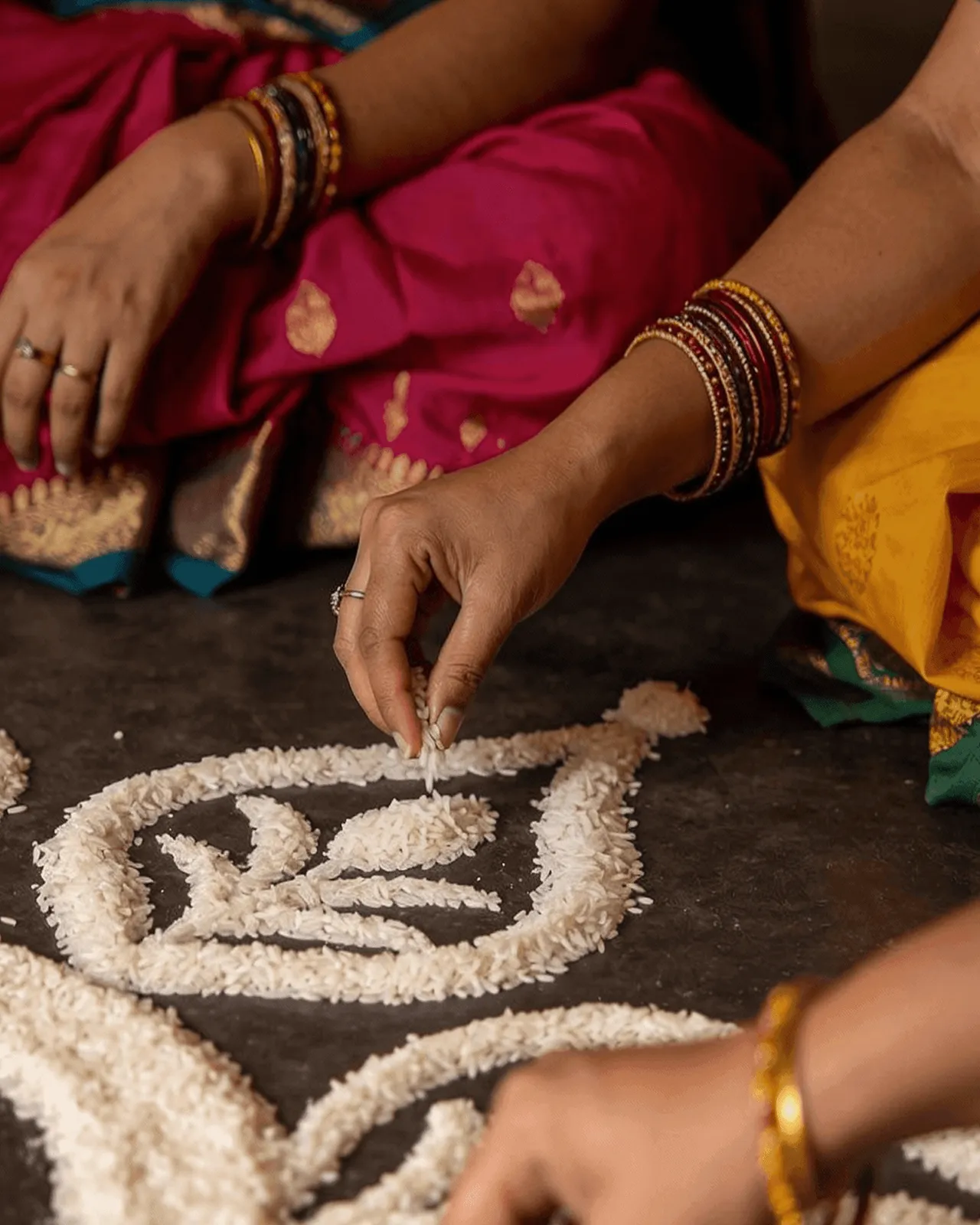
Mornings in southern India start much like anywhere else, with one small twist. Women rise before dawn, sweep the thresholds of their homes, and then sit down to draw intricate geometric patterns in rice flour.
These designs are called kolam in Tamil Nadu, rangavalli in Karnataka, and muggulu in Andhra Pradesh. They are more than decoration. They are visual rituals, mathematical constructions, and carriers of centuries-old algorithms passed orally from mother to daughter. For a long time kolams were dismissed as folk art or women’s tradition. Now most people recognise them as ancient knowledge systems that encode geometry, logic, memory, and computation. They are an unwritten algorithmic tradition, rooted in beauty and cultural symbolism, and woven into the daily lives of women in southern India.
Decoding Kolams
Symmetrical Dots and Ephemeral Art
A kolam is a symmetrical, looping pattern. You drop tiny dots of rice flour on the ground, then draw continuous lines around them in closed curves. Designs range from simple grids to very complex arrangements, all drawn freehand. Kolams are traditionally drawn outside home entrances. They stand for good fortune, welcome prosperity, and ward off evil. They also double as an offering to birds and ants, a small daily act of non-violence and sharing. Kolams do not last. Wind, rain, or footsteps slowly erase them, so they are redrawn every day. Over time the patterns settle into the muscle memory of the women who draw them with religious dedication.
A Women-Led Tradition
Mathematical Logic Without Formulae
At first glance a kolam may look like mere ornament. Look closer and you find a powerful form of mathematical reasoning in its loops and curves.
Kolams rest on symmetry, geometry, and pattern recognition. This is maths practised without formulae or formal instruction. Most of these women never studied mathematics at school. Yet through kolam they build layered complexity from dot matrices and construct repeating motifs using modular transformation and similar ideas, all by intuition.
Algorithmic Rules in Hand-Drawn Forms
Kolams embody algorithms. They tell you where to start, where to loop, where to mirror a shape, and where to end, much like the rules of construction in computer science. The genius of kolams is that these rules live in the hand-drawn form, never written down.
Kolams and Computational Thinking
Reverse-Engineering into Digital Code
In recent decades, more and more people have decoded kolams through the lens of computer science. For instance, Dr. Nagalakshmi and her team at Anna University built software that generates kolams from input patterns, turning traditional methods into digital code. Mathematician Dr. Sriraman went further. He described kolams as a form of graph theory and lattice math, practised long before these concepts were formally defined.
Lindenmeyer Systems and Fractal Geometry
Each kolam is a piece of visually coded logic, with possible uses in robotics, computer graphics, and generative design. One especially intriguing type is the pulli kolam, drawn on a dot grid with continuous lines. Researchers have modelled these kolams as Lindenmeyer systems: an algorithmic system used to simulate plant growth, fractals, and other natural forms.
Cultural Memory and Mapping
Mnemonic Libraries of Geometric Shapes
What makes kolams even more remarkable is that they are often held entirely in memory. Women memorise hundreds of patterns and reproduce them with unmatched accuracy and creative variation. No notebooks, no sketches. It is as if the mind has become a library of geometric forms.
Structure, Improvisation, and Heirloom Styles
Seen this way, kolams are mnemonic devices, not so different from oral epics or musical ragas, where structure and improvisation live together. For some families, kolam styles are almost heirlooms. They pass to the next generation as cultural heritage and appear in marriage rituals, festivals, or caste-specific customs.
Kolams of Resistance and Reclamation
Intellectual Labour and Patriarchal Spaces
Beyond the maths, kolams carry layers of social meaning. As a women-led practice, kolams are an enduring form of women’s intellectual labour, the kind that patriarchal and colonial systems of knowledge have long ignored.
Women were rarely given a place in formal science. But in the yards of their homes, they quietly practised algorithms, encoded memory, and mapped symmetrical logic every single day. Perhaps kolams were their own unconscious way of claiming importance in a field long reserved for men.
Claims to Space, Knowledge, and Dalit Identity
In recent years, feminist scholars have reread kolams as quiet struggles against the ongoing effort to erase and undermine women’s intellectual contributions. They see them as a claim to space and knowledge, and as a language for the marginalised, especially in rural and Dalit homes, where kolams take their own unique and unconventional forms.
Drawing the Line from Past to Future
Digital Revivals and Algorithmic Art
Globalisation is a constant threat. Hand-drawn kolams are increasingly replaced by vinyl stickers or printed mats. In response, many young artists are reviving kolam traditions through digital art, workshops, and coding platforms. There are kolam-generating apps, workshops that pair kolams with coding to draw in younger people, interactive art installations like those by artist Ranjani Shettar, and even kolams used to train artificial intelligence models in pattern recognition and design. Kolams are cultural algorithms, and maps of memory, maths, and meaning.
Grounding Modern Algorithms in Ancient Wisdom
They are an ancient knowledge system, formalised not in books but kept alive through repetition, touch, and the rhythm of everyday life. When we honour kolams, we acknowledge the intellectual labour of countless unnamed women who practised complex ideas in simple spaces. They never called it science, yet they embodied it with elegance. In a world chasing complex code and algorithms, perhaps we should first pause and look at the ground beneath our feet. There, in rice flour drawings glistening in the morning light, is a wisdom we are only beginning to grasp.